In the tribune CFL Québec
A CFL team in Quebec City? The real game will be played around the $350 million stadium
24 sept. 2026 · 2 vues
We can talk about William Trudel.
We can talk about the reported vote of the nine governors of the Canadian Football League.
We can dream of a Quebec City-Montreal rivalry and imagine 25,000 people in the stands to welcome the Alouettes.
But sooner or later, every discussion surrounding the CFL in Quebec City comes down to exactly the same place.
The stadium.
And more precisely to one number: approximately $350 million.
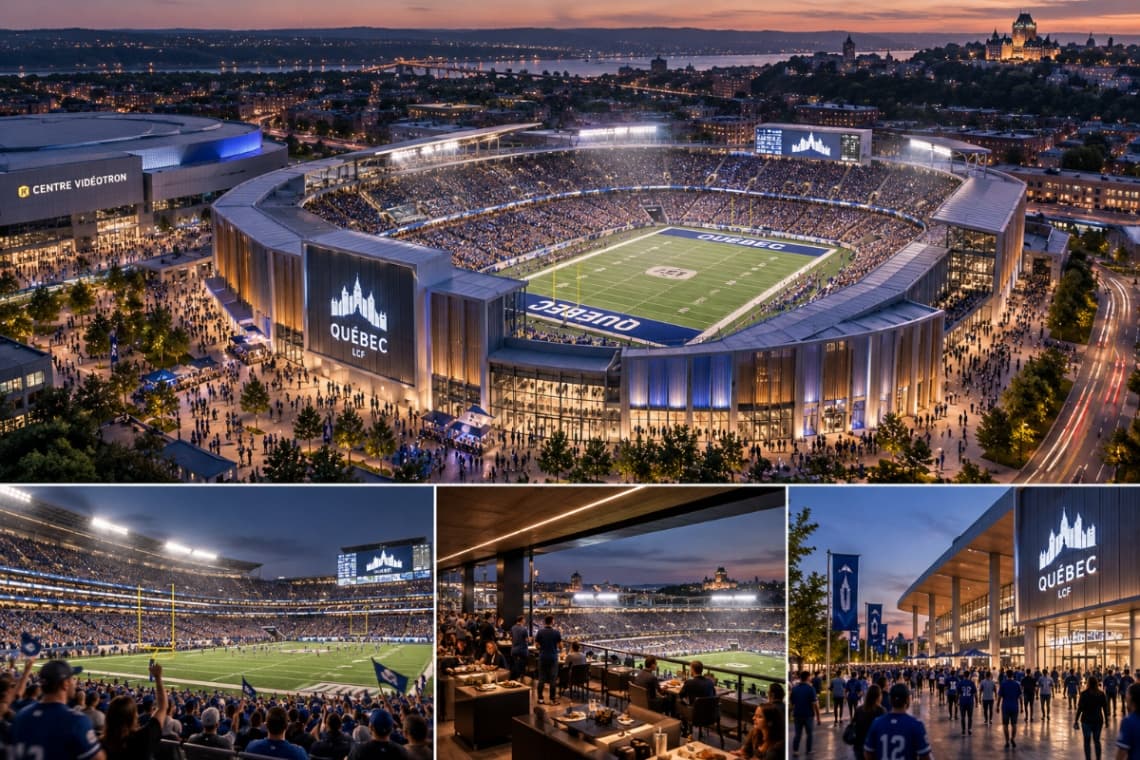
According to information circulating since June and resurfacing this week, the proposed project would include the construction of an outdoor stadium with approximately 25,000 seats on the site of the Quebec City Coliseum.
It's probably the most important piece of this entire file.
Because a professional football team can be relatively affordable to obtain compared to the major North American leagues.
A modern 25,000-seat stadium is not.
TELUS Stadium can serve as a bridge, not a destination
At first glance, some might pose a perfectly legitimate question: why build another stadium when Quebec City already has Université Laval's?
The answer lies partly in the numbers.
TELUS Stadium has 12,817 seats and an announced maximum capacity of 18,000 people. It has a press gallery, private lounges and the infrastructure necessary for Canadian football.
To temporarily host a CFL franchise, that's defensible.
To become its permanent home, that's another story.
A professional organization must generate revenue from its luxury boxes, corporate spaces, concessions, commercial activations, sponsorships and different ticket categories.
The stadium is therefore not just the place where you put 25,000 chairs around a field.
It's an important part of the business model.
Jacques Tanguay, long associated with the success of the Rouge et Or football program, has been very supportive of the CFL's arrival in Quebec City. According to information reported by 3DownNation, he believes however that a new stadium would be necessary.
And the Coliseum site is intriguing
There's something particularly interesting about the proposed location.
The old Coliseum must be demolished. Its land is located right next to the Videotron Centre.
Over time, one could imagine a true sports and events district around ExpoCité rather than a stadium built in isolation somewhere on the outskirts.
On paper, that works.
But that's where the difficult questions begin.
A $350 million stadium doesn't finance itself with a few football games and hot dogs.
What portion would be assumed by private investors?
What contribution would be requested from the City?
From the Quebec government?
From Ottawa?
Could the project integrate other uses capable of generating revenue?
Concerts? Soccer? University events? Amateur football? International events?
For now, we don't know the financial structure. And until we do, it will be difficult to have a serious discussion about the infrastructure's viability.
We need to separate two debates
That's probably the most important thing to take away.
There are really two different projects.
The first is bringing a CFL team to Quebec City.
The second is building a $350 million stadium.
You can perfectly believe in the commercial potential of a team while demanding more information about stadium financing.
Conversely, a multi-purpose stadium could eventually present broader interest than just the CFL, but it would then be necessary to demonstrate what additional events it would host and what revenue it could generate.
So we need to avoid mixing everything together.
The CFL seems genuinely interested in Quebec City. Sportsnet reports that the league now considers the capital one of its main expansion candidates and sees several favorable market characteristics.
That's significant.
But it doesn't answer the stadium question.
One advantage: we have time
The timeline reported by FM93 places a possible arrival around 2030 or 2031.
And ultimately, that might be great news.
Because there's no reason to rush this file.
If a team can temporarily play its games at TELUS Stadium, Quebec City could even have an interesting transition period.
Imagine the scenario.
A franchise is officially awarded.
You start selling season tickets.
The team plays its first season at the PEPS.
We actually measure demand.
Meanwhile, the new stadium is being built.
It would be almost a full-scale laboratory.
If 18,000 people show up regularly, the commercial arguments become much easier to demonstrate.
If enthusiasm is more modest, you also possess extremely important information before completing an investment of several hundred million dollars.
The Grey Cup potential
FM93 also reports that Quebec City could host the Grey Cup from the beginning of the franchise if the new stadium comes to fruition.
That would obviously be a major event.
A Grey Cup is not just a football game. It's a full week of activities that attracts fans from across the country.
But again, you'll need to distinguish the event promise from the long-term economic model.
A Grey Cup can fill a stadium.
The real challenge is filling it regularly in the decades that follow.
This is when the project becomes interesting
For a long time, the question of the CFL in Quebec City could be summed up like this: would the league be interested?
Today, the answer seems to be much clearer.
Yes, it would.
It publicly acknowledges discussions with a serious local group. It qualifies Quebec City as an important candidate. Several media outlets even report that a vote by the governors opened the door to continuing the project.
The next obstacle is therefore no longer simply sports-related.
It's real estate, financial and political.
And before knowing if Quebec City will have its CFL team, we'll probably need to answer a much more down-to-earth question:
How do you build a $350 million stadium and, most importantly, who pays for it?
That's probably where the real game will be played.