In the tribune CFL Québec
CFL in Quebec: What if Rouge and Or is the best proof the project can work?
24 sept. 2026 · 2 vues
There's a question that comes up every time we talk about a possible Canadian Football League team in Quebec.
And Rouge and Or?
For years, the two have been presented as if they were incompatible.
Quebec already has its football team. It plays at Université Laval. It wins. It attracts impressive crowds. It's deeply rooted in the community.
Why risk dividing the market?
The question is legitimate.
But the more the CFL project becomes concrete, the more I think we might have been looking at the problem completely backwards.
Rouge and Or may not be the obstacle to a professional franchise.
It may be exactly the best demonstration that Quebec is a different kind of football market.
16,018 people for university football
Let's just look at what just happened.
On September 19, Rouge and Or hosted Vert and Or from Sherbrooke at Stade TELUS.
Attendance: 16,018 people.
Not for a national championship.
Not for a professional team.
For a regular season university game.
Stade TELUS officially has 12,817 seats and can accommodate up to 18,000 spectators.
In the context of Canadian university football, this drawing power is remarkable.
And the CFL knows it.
Its commissioner Stewart Johnston himself mentioned the passion of Quebec football fans and the pride surrounding Rouge and Or when he talked about the market this week. The league also says it sees in Quebec an interesting combination of sports passion, community and corporate support, and market growth.
In other words, Rouge and Or's success is part of the argument for Quebec.
Jacques Tanguay doesn't seem worried
Another element is particularly revealing.
Jacques Tanguay, a figure intimately associated with the development of Université Laval's football program, has been very supportive of the project.
In an interview on FM93, he said he believes a CFL franchise in Quebec could achieve significant success. 3DownNation also reports that he sees Rouge and Or as a potential enthusiastic backer of the project, while emphasizing the need for a new stadium for the professional franchise.
That deserves attention.
If there was anyone who might naturally fear that a professional team would cannibalize Rouge and Or's market, it would be precisely one of the builders of that program.
Yet the discourse is rather one of complementarity.
And I think that's where the project becomes truly interesting.
Quebec could have a genuine football culture
In many sports markets, a professional team must practically build its fanbase from scratch.
In Quebec, that wouldn't be the case.
There are already thousands of people who know Canadian football.
Young people play football.
Schools have programs.
Rouge and Or has been followed for decades.
Fans understand Canadian rules and know what it's like to experience an outdoor fall game.
That's not a detail.
A professional franchise could arrive in a market where much of the cultural groundwork is already done.
The CFL wouldn't have to explain why football deserves a place in Quebec's sports landscape.
It would instead need to convince fans that this new team is theirs.
And that's a very different mission.
But be careful not to jump to conclusions
Rouge and Or's success doesn't guarantee a professional team's success at all.
It's important to say that.
Previous CFL experiences in Quebec did produce fairly ordinary results.
According to 3DownNation, 10,358 spectators attended a preseason game between the Alouettes and the Ottawa Renegades in 2003. In 2015, another preseason game between Montreal and Ottawa drew only 4,778 people.
Those are numbers we can't simply ignore because they don't fit with current enthusiasm.
But there's a fundamental difference.
None of those teams represented Quebec.
It was CFL football played in Quebec.
It wasn't Quebec's team.
And in professional sports, local identity changes a lot of things.
Quebec-Montreal could become the engine
This is where the project has an advantage that's almost impossible to replicate elsewhere.
The Alouettes.
A Quebec team would immediately create a provincial rivalry.
The CFL itself identified this as one of the market's advantages: a second Quebec franchise would strengthen its presence in the province and create a natural rival for Montreal.
Now imagine that dynamic combined with university football's.
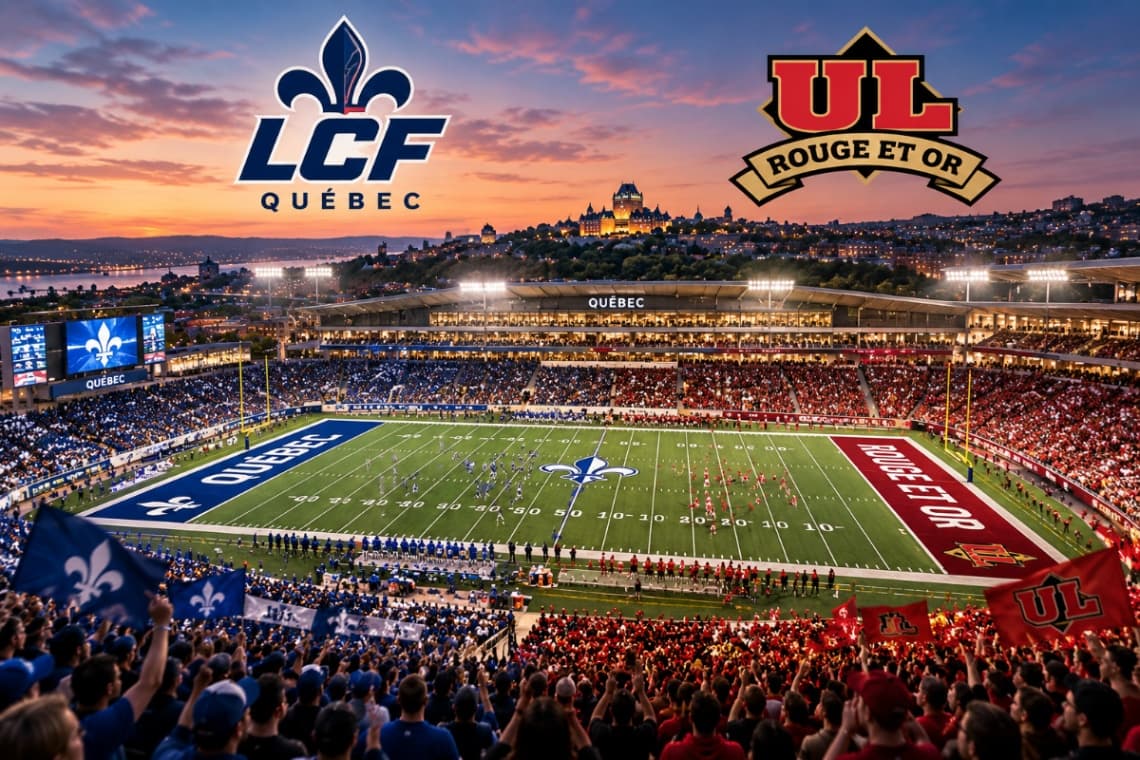
In the fall, Quebec could have Rouge and Or on Saturday and a CFL team on Sunday.
University players could eventually move to the professional level.
Young people could follow both.
Sponsors could be present throughout the entire ecosystem.
And football could occupy a much larger place in the region's media landscape.
Games obviously wouldn't be scheduled carelessly. Collaboration between organizations would be essential to avoid unnecessarily fighting over the same spectators at the same times.
But if that collaboration exists, one could very well feed the other.
PEPS as first home would be symbolically perfect
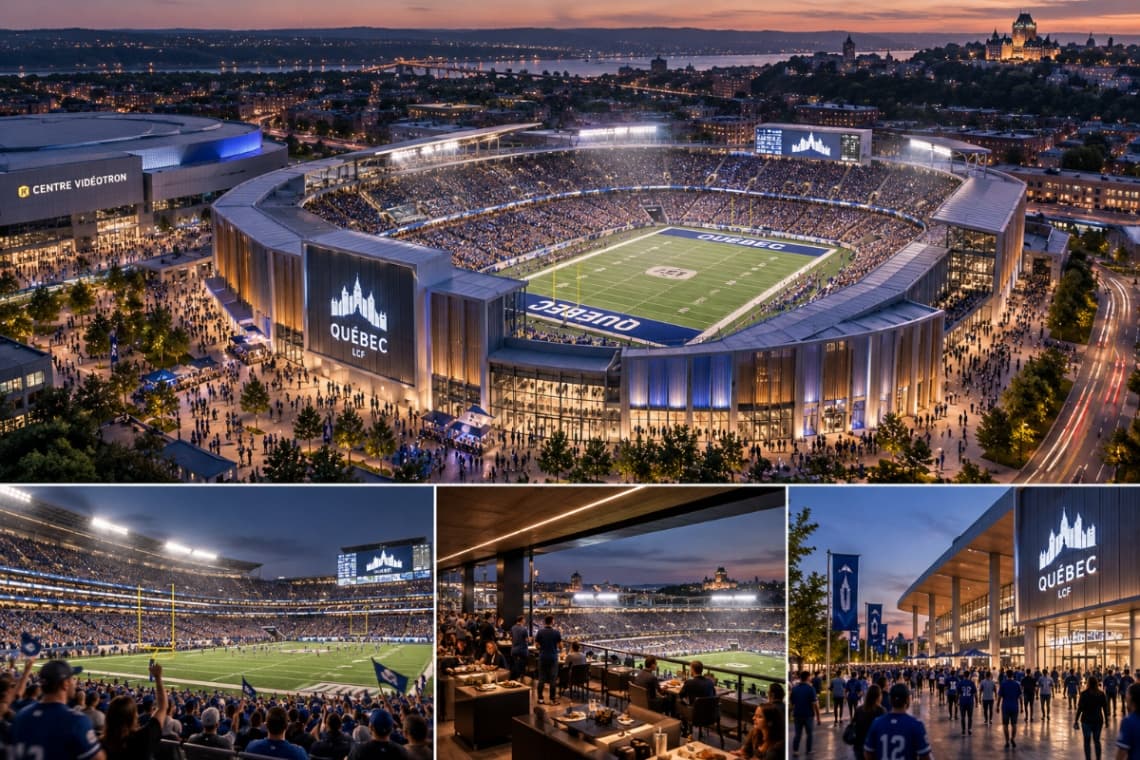
According to circulating reports, a potential team could even play one or two seasons at Stade TELUS before the opening of a new 25,000-seat stadium at the Coliseum site.
I find the idea fascinating.
Not necessarily as a permanent solution: the university stadium is too small for the long-term envisioned model.
But as a starting point?
Hard to imagine a better symbol.
The new professional team would begin its history at exactly the place where Quebec built its reputation as a football city.
Then it would eventually move to its own home.
Football rather than just the CFL
Maybe that's how we need to think about the project.
The question isn't necessarily whether Quebec can support Rouge and Or plus a CFL team.
The question is whether Quebec can become a genuine football market, with different levels that reinforce each other.
We already have the university base.
We have the fans.
We have a tradition.
According to reports that came out this week, a group of investors is now working seriously on a professional franchise and the CFL considers Quebec as one of its main expansion candidates.
There are still many missing pieces.
Stadium financing remains a major question. The exact identity of the investor group hasn't been officially announced. And despite reports surrounding a governors' vote, no franchise has yet been formally awarded.
But one thing becomes hard to dispute: Quebec doesn't need to discover football.
It already loves it.
A future organization's challenge would be to transform this passion for football in Quebec into passion for a professional Quebec team.
And Rouge and Or could be less a competitor than a fantastic starting point.