In the tribune CFL Québec
CFL in Quebec: Where does Pierre Karl Péladeau fit into all this?
24 sept. 2026 · 169 vues
Since William Trudel's name came out publicly in the file on a possible Canadian Football League franchise in Quebec, another question becomes particularly intriguing.
Where does Pierre Karl Péladeau fit into all this?
The question is far from outlandish.
Péladeau is the owner of the Montreal Alouettes. Quebecor operates the Videotron Centre. He has long been interested in the development of professional sports in Quebec. And most importantly, he has already declared himself in favour of the arrival of a second CFL team in the province.
But after digging through the information that has come out over the past few days, an important distinction must be made.
At this time, there is nothing credible that suggests Péladeau is an investor in the group led by William Trudel.
The project reported in Quebec appears to be Trudel's and possibly that of other investors who have not yet been publicly identified.
However, PKP is already much closer to the file than one might think.
Péladeau has already voted on Quebec
This is probably the most interesting detail of the entire story.
According to information from TVA and FM93, the nine CFL governors allegedly voted unanimously on September 9 to allow the Quebec project to move forward.
Among these nine owners is obviously Pierre Karl Péladeau.
In other words, if the information concerning this vote is accurate, the owner of the Alouettes did not attempt to protect his market against the arrival of a competitor in Quebec.
He voted to advance the project.
3DownNation goes even further and reports that Péladeau is fully in favour of the arrival of a second CFL franchise in Quebec.
This is not entirely a new position anyway.
In 2025, Péladeau was already saying publicly that expansion was desirable and that he would find it wonderful if Quebec obtained a franchise. He notably raised the obvious problem of a league made up of nine teams.
So on one thing, there seems to be very little ambiguity:
PKP wants a CFL team in Quebec.
The real question is how far this support goes.
There is a huge detail: the Alouettes' territory
This is where the file becomes particularly interesting.
The CFL constitution assigns territories to different franchises.
And historically, the territory assigned to the Alouettes is not simply Montreal.
It is essentially the province of Quebec, with the exception of an area near Ottawa.
This is not a journalistic interpretation. The text of the CFL constitution available from the federal government specifically states that the Montreal territory includes Quebec, except for the portion within a 120-kilometre radius of the Peace Tower in Ottawa. The CFL itself reiterated this definition in an official publication concerning its territorial choices.
Obviously, the league can modify its territories as part of an expansion.
It will even necessarily have to do so if Quebec becomes the tenth franchise.
But that means something important:
you cannot simply place a team in Quebec as if the Alouettes did not exist.
The current territory of Montreal will need to be redefined.
And the governor representing the Alouettes at the table is Pierre Karl Péladeau.
This is why his favourable vote on September 9, if confirmed in the details reported, becomes particularly significant.
But that doesn't mean PKP becomes owner in Quebec
This is where we need to avoid taking a shortcut.
Pierre Karl Péladeau has personally owned the Alouettes since 2023. The CFL had officially presented him at that time as the buyer of the franchise and as the governor representing Montreal on the league's board.
In Quebec, the information currently available tells a different story.
FM93 identifies William Trudel, president and chief executive officer of Groupe Trudel, as the man leading the project. Stewart Johnston apparently even met with Trudel personally in Quebec in recent weeks.
Groupe Trudel is for now refusing to publicly confirm its involvement, but has not directly denied it either.
The CFL simply speaks of a "serious and determined local group" with which it has had productive discussions.
None of these reports identify Péladeau as a member of this group.
For now, we must therefore consider Groupe Trudel and Alouettes ownership as two separate files.
But separate does not necessarily mean independent.
Because Quebecor is already installed right next door
Let's now look at the other piece of the puzzle.
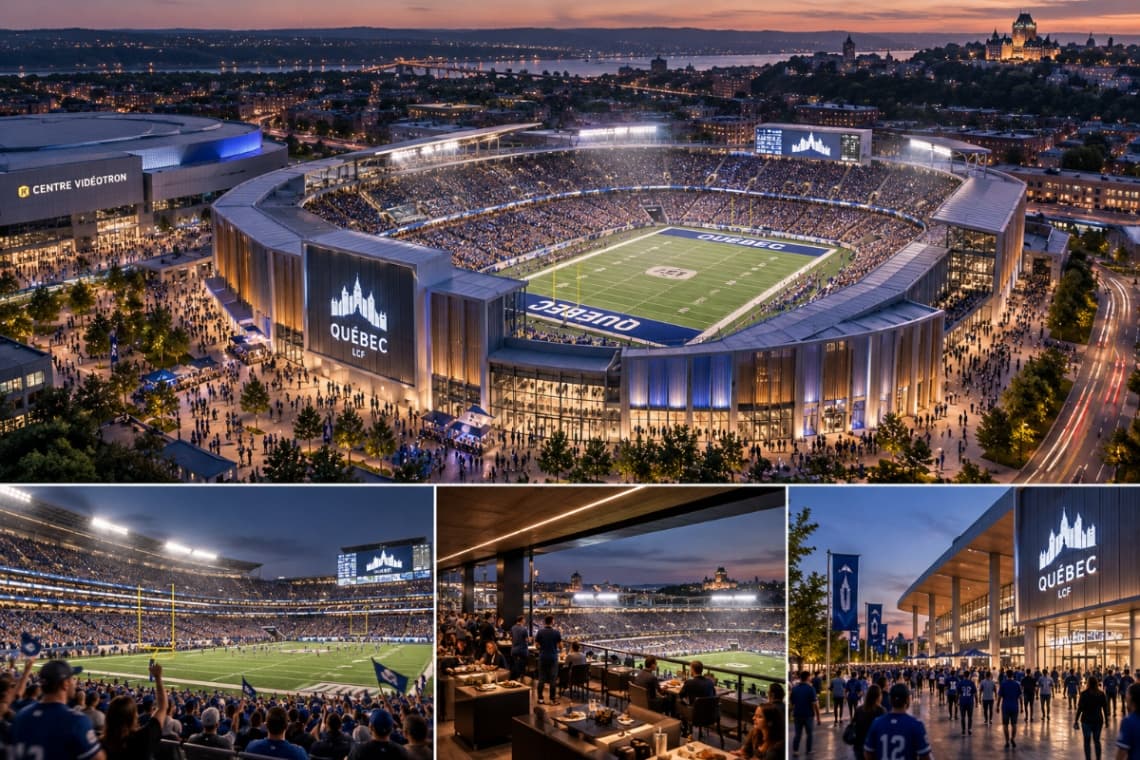
The scenario currently reported involves the construction of a stadium of approximately 25,000 seats, valued at 350 million dollars, on the site of the former Coliseum.
And what is located immediately in that area?
The Videotron Centre.
And who operates the Videotron Centre?
Quebecor.
3DownNation moreover directly highlights this connection when speaking of Péladeau's support for the project: he is the owner of the Alouettes and heads Quebecor, which operates the Videotron Centre in Quebec.
This absolutely does not prove that Quebecor will participate in the future stadium.
But commercially, the proximity is difficult to ignore.
If a football stadium of 25,000 seats were truly built on the Coliseum grounds, it would find itself at the heart of the same events district as the Videotron Centre.
One could then imagine all sorts of collaborations around programming, sponsorships, suites, hospitality, events, ticketing or operations.
These are possibilities, not confirmed information.
But they explain why Péladeau could have an economic interest in the success of the project without necessarily owning a single share of the future team.
And what would become of the Alouettes?
This might be the most fascinating question.
At first glance, one might think that a team in Quebec would be bad news for Montreal.
The Alouettes would lose the exclusivity of a good part of their Quebec territory.
But another reading is possible.
The Alouettes would gain something that money hardly buys: a genuine rival.
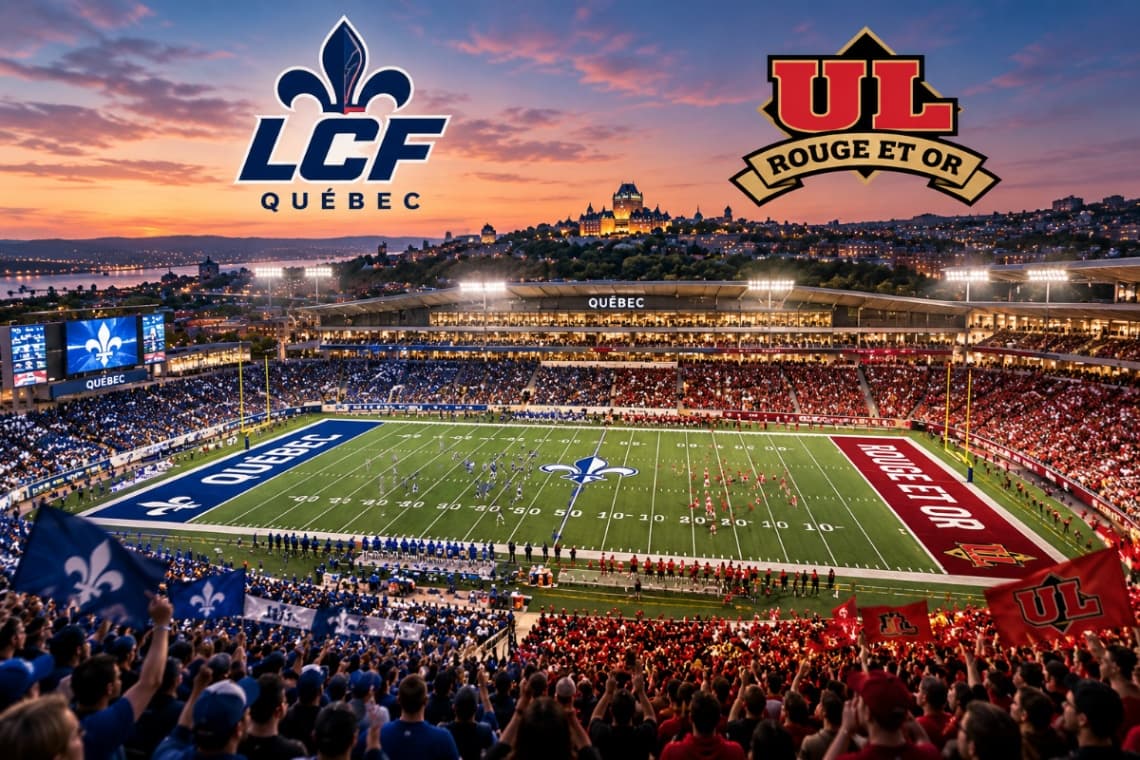
Montreal-Quebec.
Two francophone teams.
Two markets separated by approximately 250 kilometres.
Home-and-away games.
Fans who can easily travel from one city to the other.
Much more significant provincial media coverage of the CFL.
A Quebec-Montreal week could quickly become one of the easiest events to sell in the season.
The CFL itself explicitly identifies this potential provincial rivalry as one of the advantages of the Quebec market.
And this might be exactly why Péladeau sees bigger than protecting the current territory of the Alouettes.
The Alouettes also seem to be continuing their own project
There is currently no sign that Péladeau is preparing to disengage from the Alouettes to turn to Quebec.
On the contrary.
On September 1, the Alouettes extended the contracts of Danny Maciocia and Jason Maas by two seasons. Maciocia is now tied to the organization until 2031 and Maas until 2030.
Look at the dates.
2030 and 2031.
That is precisely around 2030-2031 that FM93 information places the possible arrival of the Quebec franchise.
This is obviously not proof of anything.
But it certainly does not look like an owner preparing his exit from Montreal.
The most cautious reading currently would rather be this one: Péladeau continues to build the Alouettes in Montreal while supporting the arrival of a second franchise in Quebec.
And there is even an interesting precedent this year.
The Alouettes held their 2026 training camp at the PEPS of Université Laval, from May 10 to 29.
Professional football in Montreal and the Quebec football ecosystem have therefore already begun to come closer before the expansion project even truly came out of the shadows.
And what if PKP simply had an interest in Trudel succeeding?
This is ultimately the hypothesis I find most interesting.
We may be trying too hard to find out whether Péladeau is part of William Trudel's group.
He may absolutely not need to be part of it.
William Trudel could own the Quebec franchise with his own group of investors.
Péladeau could continue to own the Alouettes.
The two could become rivals on the field while having an interest in growing the CFL in Quebec considerably.
And Quebecor could eventually find commercial opportunities around the new stadium or the sports ecosystem of ExpoCité without owning the team.
Everyone could benefit without necessarily having common ownership.
For now, that is what the available facts most strongly suggest.
One thing does seem certain, however: PKP is not an obstacle
For a long time, one question could have immediately killed the project:
Why would the owner of the Alouettes accept a second team moving into his territory?
We now have at least part of the answer.
Because he seems to want that team too.
Péladeau had already publicly shown himself to be in favour of Quebec. The information from this week now indicates that he may have been part of the unanimous vote allowing the file to move forward.
William Trudel appears to be the one currently driving the future franchise project.
Pierre Karl Péladeau remains the one who owns the Alouettes.
To date, no solid information makes it possible to bring the two men together within the same group of investors.
But if the Quebec project continues to advance, their paths will almost necessarily cross.
The territory of the Alouettes will need to be redefined. The Quebec-Montreal rivalry will need to be created. The presence of the CFL will need to be developed throughout the province. And if the 350-million-dollar stadium truly sees the light of day on the Coliseum site, it will be built directly in the events ecosystem where Quebecor is already a major player.
Péladeau therefore does not need to be behind William Trudel's project to become one of the important characters in its story.
And perhaps the best question is not ultimately:
"Is PKP part of Quebec's group?"
But rather:
"What does PKP see in a Montreal-Quebec rivalry to have already decided he wants it to exist?"
This answer is likely to be particularly interesting to discover over the coming months.